

Scale-Up Ethernet Moves From Standards to Production, Unlocking a $100B+ Scale-up TAM by the end of the Decade

Table of contents
Author
Introduction
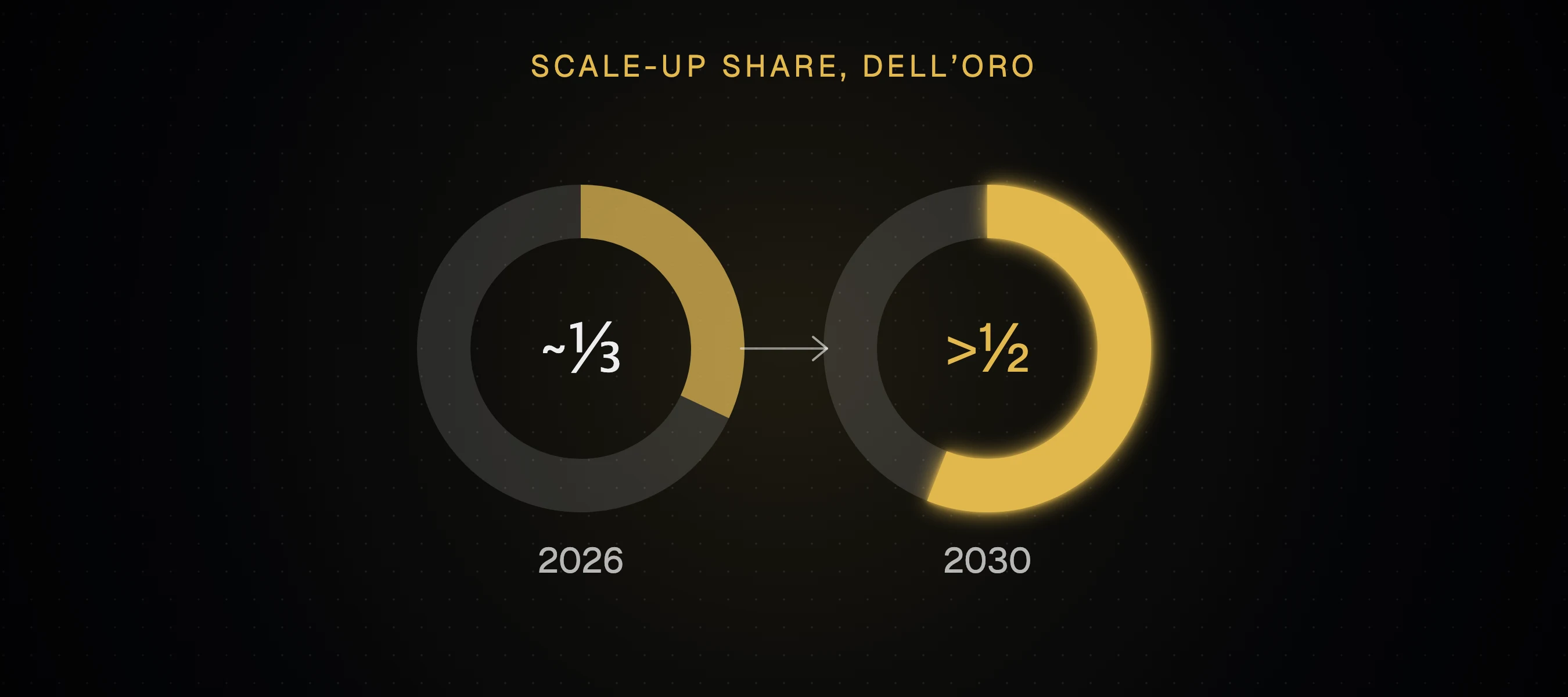
In the early days of AI networking, there was fierce debate between whether InfiniBand or Ethernet would dominate the scale-out backend network. Ethernet ultimately became the larger market in 2025, led by customers wanting a single network that was GPU/XPU agnostic, with a large pool of supply chain participants and network engineers. Scale-up is going through a similar debate with the same clear outcome. Ethernet will make up a larger portion of scale-up and eventually be the largest technology segment there. That scale-up layer sits inside a broader Token Fabric, where scale-up, scale-out, and the front-end create full data center scale instead of just trying to optimize individual components.
Why Scale-Up Is a Different Networking Problem
Scale-up is the fabric that turns a rack of GPUs and XPUs into one memory domain, and it is becoming one of the largest incremental pieces of AI networking this decade. Proprietary scale-up links still carry most of the traffic today. That will not last. Hyperscalers, merchant XPU vendors, and neoclouds need one open fabric that can attach any accelerator, keep latency deterministic, and scale from a tray to a multi-rack domain. Each XPU/GPU can't have its own rack; that breaks the supply chain and adds too much operational complexity, even for the largest hyperscalers. Ethernet, with ESUN as that fabric, and purpose-built networking silicon push the industry towards that converged fabric.
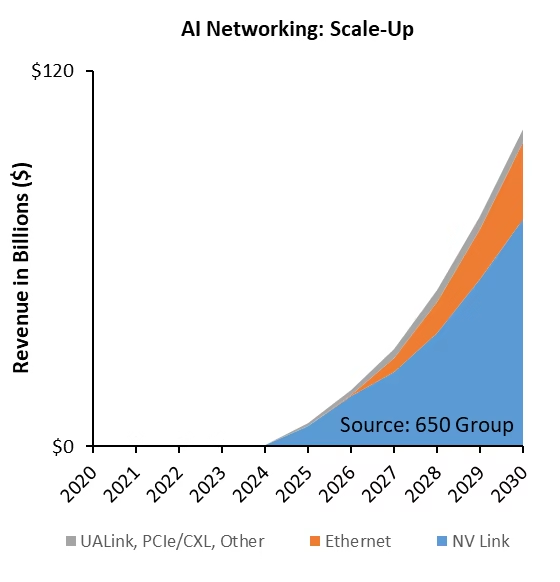
Scale-out can tolerate extra hops and software congestion. Scale-up cannot. Expert parallelism, KV cache movement, and memory-semantic traffic punish tail latency. A token that waits on the fabric is a wasted accelerator cycle. Operators therefore want larger scale-up domains, fewer tiers, and line-rate behavior on small packets as well as large flows. Silicon has to support both these requirements without breaking the software model. We forecast scale-up, including switching and optics, at over $100B by the end of the decade (Figure 1), with Ethernet's share increasing each year.
ESUN Makes Ethernet the Scale-Up Control Point
The Open Compute Project Ethernet Scale-Up Networking workstream standardizes the network side of the problem: framing, lossless behavior, link resiliency, and interoperability between XPU interfaces and switch ASICs. Link Level Retry recovers errors at the link instead of waiting on end-to-end transport. Credit-based flow control keeps the fabric lossless and maintains all-to-all traffic. Compact headers such as AFH and UFH cut overhead on the small messages that dominate synchronization. UALink can ride Ethernet as UALoE. RoCE, Ethernet, and IP remain available on the same ports. The point is not one protocol forever. The point is one open forwarding plane that can carry memory semantics and Ethernet-native traffic without forking the supply chain. Ethernet and ESUN provide this for the industry. ESUN is the scale-up control point of the Token Fabric, so memory semantics and Ethernet-native traffic share one forwarding plane.
Heterogeneous Compute Only Works If the Fabric Is Open
The accelerator mix is no longer one vendor and one generation. Custom XPUs, merchant GPUs, and inference-specific processors will share the same pod. A closed scale-up link forces operators to partition the factory by accelerator type. An open ESUN fabric lets the operator choose the XPU and keep the network constant. That is how utilization stays high as the fleet turns over. SAI and SONiC compatibility matter here. Hyperscalers will run their own stack on silicon and switch trays. XPU partners and neoclouds will take a validated system with an AI-optimized NOS. Enterprises will take the full stack, including orchestration. The silicon has to support all three consumption models, or it will miss part of the market. It's important to note that scale-up innovation is rapid, so switch trays and copper will quickly give way to switch racks and CPO/Interposers. Therefore, the silicon needs to be forward-looking.
Purpose-Built Scale-Up Silicon Changes the Economics
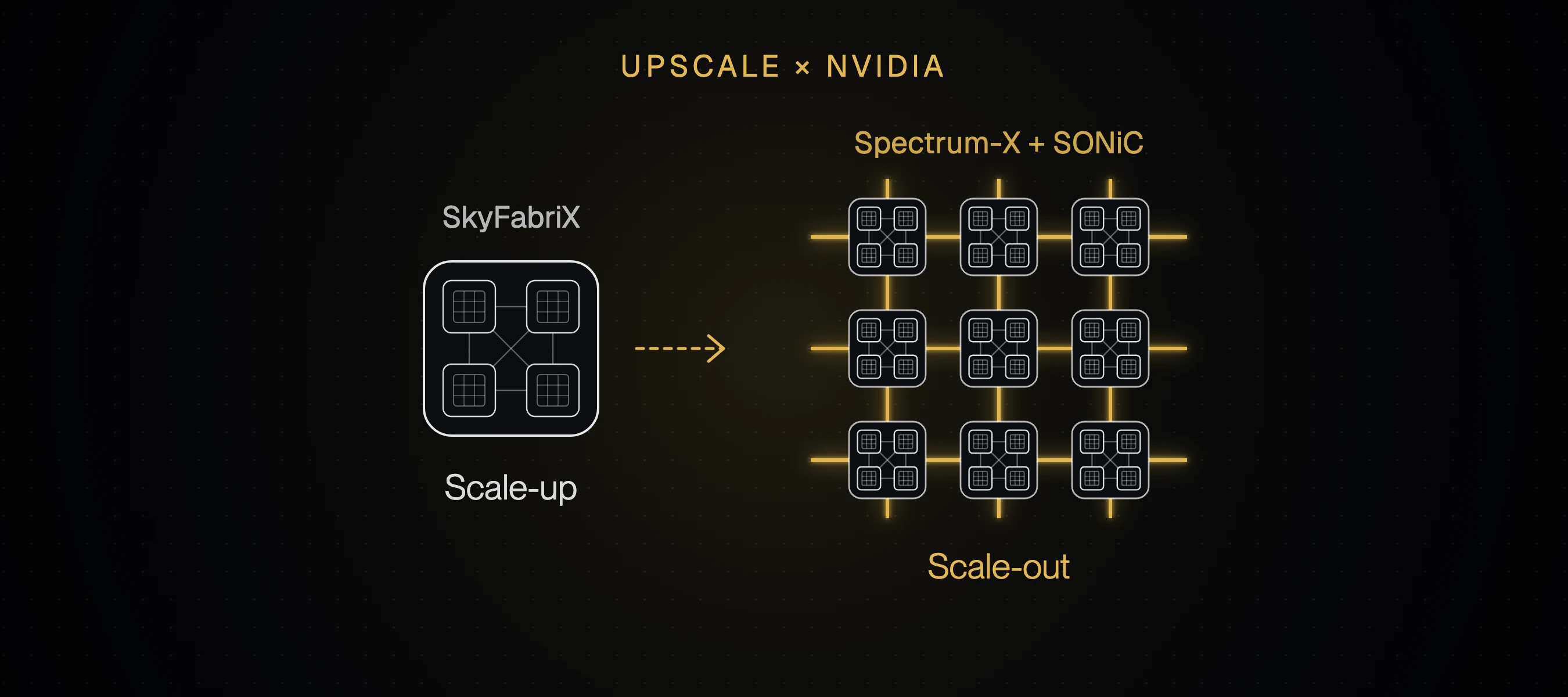
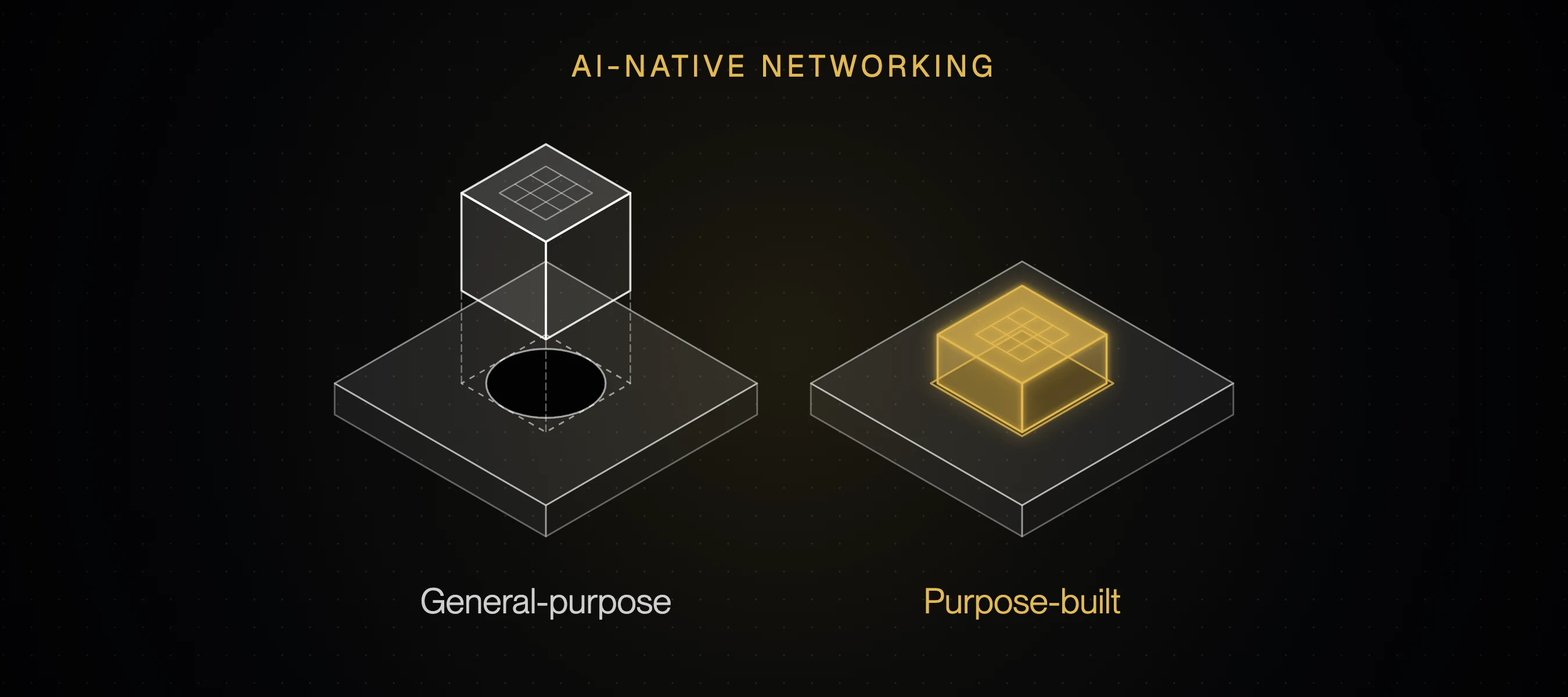
General-purpose Ethernet switches were never designed as memory-semantic scale-up engines. The first purpose-built ESUN products are now here. Upscale's SkyFabriX SFX1 is 115.2 Tbps with up to 576 x 200G interfaces. It has copper and optical variants, and 12.5 percent more usable bandwidth than 102.4 Tbps alternatives to match the GPU/XPU density of a rack. It also has up to 3x lower latency than general Ethernet switches. Upscale has already provided a roadmap toward 1 Pb/s on the same architecture. Scale-up silicon, networking trays, and racks should be generating tokens by the first half of 2027. That timing lines up with the next XPU generation and with ESUN moving out of the working groups and into production.
Scale-Out and Software Complete the Token Fabric
While scale-up focuses on the ultra-low-latency that turns a rack of heterogeneous XPUs into a single coherent XPU, scale-out provides the Ethernet fabric that interconnects those domains across the broader data center. Ethernet already won the scale-out market on the strength of a single, GPU/XPU-agnostic network, backed by a deep supply chain and a large pool of network engineers. The Token Fabric architecture unifies scale-up, scale-out, and software, enabling operators to treat the entire data center as a single coherent fabric rather than siloed networks. Software, including an AI-optimized network operating system with SONiC compatibility, orchestration, and telemetry, provides a common control plane across both layers and lets hyperscalers run their own stack, neoclouds deploy a validated system, and enterprises consume the full stack while keeping utilization high as accelerator generations turn over. Open scale-up Ethernet via ESUN, proven scale-out Ethernet, and unified software deliver the end-to-end Token Fabric required for the next wave of AI infrastructure.
Tokens per Dollar Is the Scoreboard
A token factory is judged on tokens delivered per dollar or per watt. Those tokens need to arrive on a predictable SLA. Larger domains, higher goodput, and lower tail latency all raise accelerator utilization. This is very important as we move from human-dominated to agentic-dominated workloads as these products hit production. Vendors that deliver open scale-up silicon, systems, and software will take a disproportionate share of that growth as the AI networking market moves towards over $300B a year this decade. Across the Token Fabric, scale-out adds another $100B+.
Conclusion
Scale-up is no longer a niche market to front-end scale-out. It is the layer that decides whether heterogeneous XPUs act as one computer or as individual stranded devices. ESUN gives the industry a standards path. Purpose-built silicon gives it a product path. Operators will standardize on open scale-up Ethernet with a mix of accelerators without rebuilding the fabric each generation. The Token Fabric is that architecture, tying scale-up to scale-out and the front-end, and we expect the combined AI networking market to exceed $300B a year by the end of the decade. That is the architecture the market has been waiting for, and it is now moving from working groups to production.
About author